Griess Reagent System
Measures Nitrite, a Primary Breakdown Product of Nitric Oxide
- Detects nitrate in a variety of types of biological samples

Catalog Number:
Size
Catalog Number: G2930
The Griess Reagent System measures nitrite (NO2–), one of two primary stable and nonvolatile breakdown products of nitric oxide (NO). Nitric oxide is an important physiological messenger and effector molecule in many biological systems, including immunological, neuronal and cardiovascular tissues. This assay relies on a diazotization reaction that was originally described by Griess in 1879. Through the years, many modifications to the original reaction have been described.
The Griess Reagent System is based on a chemical reaction that uses sulfanilamide and N-1-naphthylethylenediamine dihydrochloride (NED) under acidic (phosphoric acid) conditions. This system detects NO2– in a variety of biological and experimental liquid matrices such as plasma, serum, urine and tissue culture medium. The nitrite sensitivity is dependent on the matrix. The limit of detection is 2.5μM (125pmol) nitrite (in ultrapure, deionized, distilled water) using the protocol described in Technical Bulletin #TB229.
Original reference:
Griess, P. (1879) Chem. Ber. 12, 426–8.
Protocols
Complete Protocol
Specifications
Catalog Number:
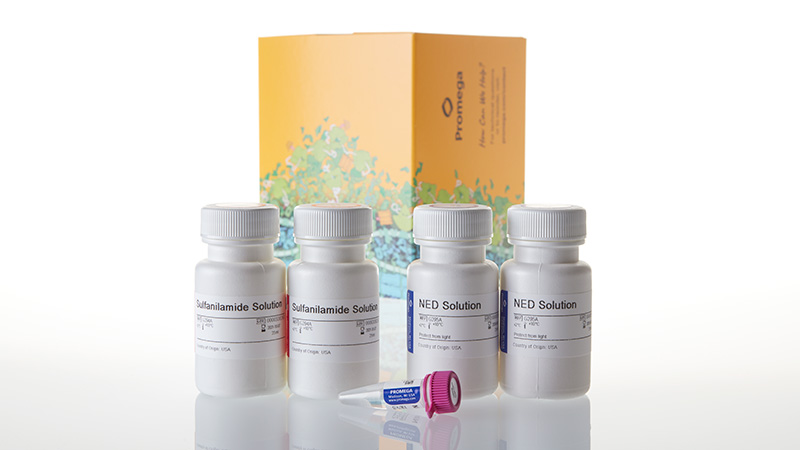
What's in the box
| Item | Part # | Choose a size |
|---|---|---|
|
Sulfanilamide Solution |
G294A | 2 × 25ml |
|
NED Solution |
G295A | 2 × 25ml |
|
Nitrite Standard |
G296A | 1 × 1ml |
SDS
Search for SDSCertificate of Analysis
Use Restrictions
For Research Use Only. Not for Use in Diagnostic Procedures.Storage Conditions
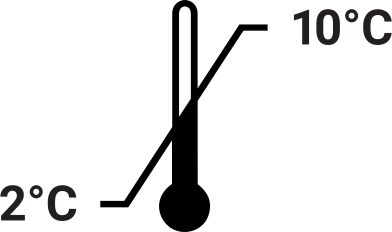 Keep all solutions in their original light-protective plastic bottles.
Resources
No related resources available
Related Products
No related products available